On this page
The flaw of Widmark's formula on a smartphone
Apps that offer a “blood alcohol calculator” almost universally rely on the Widmark formula, an equation developed by Swedish physician Erik Widmark in 1932. Widmark’s formula divides total ingested ethanol by body weight multiplied by an average gender factor, and subtracts a steady hourly elimination rate (typically 0.015 g% per hour).
In a clinical laboratory where dose, timing, fasting state, and elimination are controlled, the formula provides a useful statistical average. On a smartphone during an evening out, it fails. Clinical research demonstrates that actual individual elimination rates range from 0.010 to 0.025 g% per hour—a 150% variation between individuals. Applying a static formula produces estimates that can easily be twice as high or half as low as your true blood alcohol level.
Three biological variables an app cannot know
To determine how much ethanol is circulating in your bloodstream at any given moment, a calculation would need real-time data on physiological processes that no app has access to:
- Food in the stomach: Alcohol is absorbed primarily through the small intestine. A substantial meal closes the pyloric sphincter, delaying gastric emptying. Studies indexed by the US National Institute on Alcohol Abuse and Alcoholism (NIAAA) show that drinking on an empty stomach can produce a peak BAC three times higher and twice as fast as drinking the exact same amount with food.
- Liver enzyme activity (ADH & ALDH): Ethanol is broken down by the enzymes alcohol dehydrogenase (ADH) and aldehyde dehydrogenase (ALDH). Genetic variations in these enzymes, medications, liver health, and recent drinking history cause substantial metabolic differences between people of identical weight.
- Body water percentage vs fat: Alcohol distributes exclusively into body water, not fat tissue. Two people weighing exactly 75 kg—one lean and muscular, one with higher adipose tissue—will reach completely different blood alcohol concentrations from an identical drink.
The legal and safety danger of driving estimates
The most dangerous use of an in-app BAC estimator is deciding whether someone is “safe to drive”. In the UK, the legal limit in England and Wales is 80 milligrams of alcohol per 100 millilitres of blood (35 micrograms in 100 millilitres of breath), while Scotland sets a stricter limit of 50 milligrams.
According to guidance from the NHS and road safety charities, there is no reliable way to calculate whether you are under the legal limit. An app displaying “0.04% — Safe to Drive” provides false reassurance. If a driver is involved in an incident or tested at a roadside checkpoint, a court measures actual breath or blood alcohol, not what an algorithm predicted.
What Modraly tracks instead: units and weekly limits
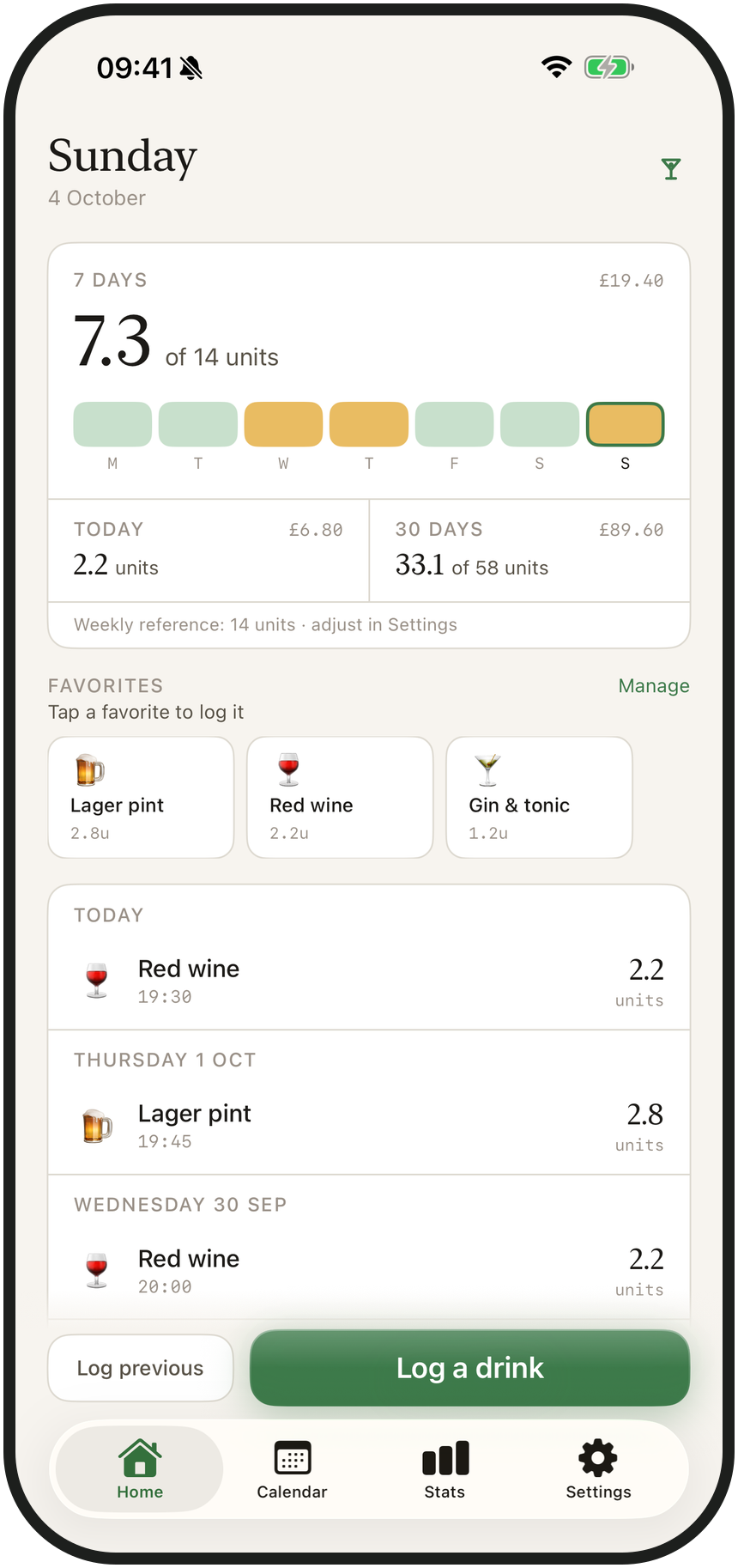
Instead of guessing blood chemistry, Modraly tracks the only metric you have direct control over: what you put in your glass.
By recording volume (ml) and strength (ABV), Modraly calculates the exact quantity of pure ethanol in official UK units (8 g), French standard drinks (10 g), or US standard drinks (14 g). It displays your cumulative weekly total next to the low-risk guideline published by your country’s Chief Medical Officers:
- In the UK: no more than 14 units per week, spread over three or more days.
- In France: no more than 10 standard drinks per week, and no more than two per day.
- In the US: two standard drinks or fewer per day for men, one or fewer for women.
This provides a factual record of health risk and spend without pretending to be a medical sensor.

Track units, spend and calories next to your country's guideline. No account, no streaks, no false promises.
Frequently asked questions
- Can an iPhone app accurately calculate my blood alcohol level?
- No. Blood alcohol concentration (BAC) depends on dynamic biological factors a smartphone cannot observe: gastric emptying speed, stomach contents, liver enzyme levels (alcohol dehydrogenase), metabolic tolerance, and hydration. Only a certified breathalyser or a laboratory blood test can measure BAC.
- Why do other alcohol apps include a BAC calculator?
- Most consumer apps use a simplified mathematical model known as the Widmark formula. Because this equation relies on averages and cannot account for real-time digestion, app developers attach legal disclaimers stating the result is for entertainment only and cannot be used to assess fitness to drive.
- How long does it take for one unit of alcohol to leave the body?
- According to the NHS, an average healthy adult liver metabolises roughly one UK unit (8 grams of pure ethanol) per hour. However, this varies significantly based on body composition, liver health, sex, and whether food was consumed with the drink.
- What does Modraly measure instead of blood alcohol?
- Modraly tracks what you actually control: the exact volume and ABV of each drink, converted into official units or standard drinks, spend, and calories. It compares your cumulative weekly intake against your country's official health guidelines without giving a false sense of security about driving.
- Can I use drink units to calculate if I am safe to drive?
- No. The UK Chief Medical Officers, the NHS, and road safety organisations state clearly that there is no safe way to calculate whether you are below the drink-drive limit. The safest approach is never to drink any alcohol if you plan to drive.