On this page
- Calculate a drink
- Add up your week
- How to work it out yourself
- Common drinks, worked out
- Alcohol calories compared to food
- Alcohol clearance: how long does the body take to process alcohol?
- Why the same drink gives four different numbers
- Embed this calculator on your website
- From one drink to a week of them
- Common questions
Calculate a drink
- UK units
- 2.6 UK (8 g)
- Verres standards
- 2.0 FR / AU / IE / NL (10 g)
- 12 g units
- 1.7 DK / IT (12 g)
- US standard drinks
- 1.4 United States (14 g)
- Pure alcohol
- 20 grams
- Calories
- 143 kcal from alcohol
A UK pint is 568 ml; a French demi is 250 ml.
Modraly does this sum for every drink you log, and adds up the week.

Calories shown are from the alcohol itself (7.1 kcal per gram). Beer, cider, sweet wine and mixers add carbohydrate calories on top, so a real pint is higher. Nothing you type here leaves your browser.
Add up your week
Enter the drinks from one week. If you had the same pour more than once at the same price, set the quantity on one line.
- UK units
- 0
- Alcohol calories
- 0kcal
- Spend entered
- —
Add the drinks from one week, or start with an example.
Rows with an incomplete volume, strength or quantity are left out of the total.
Prices are optional. Spend adds up the prices you enter in the selected currency. Calories come from alcohol alone. Your week stays in this browser tab.
Millilitres × ABV ÷ 1,000 = UK units. Multiply grams of pure alcohol by 7.1 for calorie count from ethanol alone. A 25 ml gin at 40% is 1.0 unit; a 568 ml pint of 5% cider is 2.8 units.
How to work it out yourself
- Find the volume and the strength. Take the volume of the drink in millilitres and its strength as a percentage of alcohol by volume (ABV). A UK pint is 568 ml; a large glass of wine is usually 250 ml. The ABV is printed on the bottle, the can or the menu.
- Multiply, then divide by 1,000. Multiply the volume in millilitres by the ABV percentage and divide the result by 1,000. That gives UK units. A 568 ml pint at 4.5% is (568 x 4.5) / 1000 = 2.6 units.
- Convert to grams for other countries. Multiply the millilitres of pure alcohol (volume x ABV / 100) by 0.789 to get grams. Divide the grams by 10 for French verres standards or Australian standard drinks, by 12 for Danish or Italian standard units, by 13.45 for Canadian standard drinks, and by 14 for US standard drinks.
- Add the calories if you want them. Multiply the grams of pure alcohol by 7.1 to get the calories from the alcohol itself. Beer, cider, sweet wine and mixers carry carbohydrate calories on top of that.
Common drinks, worked out
| Drink | UK units | Verres standards | US drinks | kcal (alcohol) |
|---|---|---|---|---|
| Pint of lager (4.5%) | 2.6 | 2.0 | 1.4 | 143 |
| Medium glass of wine (175 ml, 13%) | 2.3 | 1.8 | 1.3 | 127 |
| Large glass of wine (250 ml, 13%) | 3.3 | 2.6 | 1.8 | 182 |
| Bottle of wine (750 ml, 13%) | 9.8 | 7.7 | 5.5 | 546 |
| Double spirit measure (50 ml, 40%) | 2.0 | 1.6 | 1.1 | 112 |
| Gin and tonic, single (25 ml gin at 40%) | 1.0 | 0.8 | 0.6 | 56 |
| Gin and tonic, double (50 ml gin at 40%) | 2.0 | 1.6 | 1.1 | 112 |
| Pint of cider (4.5%) | 2.6 | 2.0 | 1.4 | 143 |
| Pint of cider (5%) | 2.8 | 2.2 | 1.6 | 159 |
The calorie column counts the alcohol only, at 7.1 kcal per gram. Beer, cider, sweet wine and anything mixed with a soft drink carry carbohydrate calories on top, so a pint in real life sits above the figure shown here. Spirits with a diet mixer sit close to it.
Alcohol calories compared to food
Pure ethanol carries 7.1 kcal per gram, making alcohol the second most calorie-dense macronutrient after dietary fat (9 kcal/g), and almost double the calories of sugar or protein (4 kcal/g). When residual carbohydrates in beer, cider and wine are included, standard drinks add up quickly:
- One pint of 5% lager (~215 kcal total): roughly equal to a glazed doughnut (~200 kcal) or one slice of pizza.
- One large glass of 13% wine (250 ml, ~210 kcal): roughly equal to two scoops of ice cream or four sweet biscuits.
- One standard 750 ml bottle of wine (~600 kcal): roughly equal to a full fast-food cheeseburger or large portion of fries.
- One double gin with slimline tonic (~115 kcal): one of the lowest-calorie options, containing only the calories of the alcohol itself.
- Three pints on an evening out (~650 kcal): equivalent to eating an entire extra meal.
Because alcohol calories cannot be stored directly as glycogen, your liver prioritises metabolising alcohol first, temporarily pausing the breakdown of dietary fats and carbohydrates.
Alcohol clearance: how long does the body take to process alcohol?
The human liver eliminates alcohol at a remarkably steady rate through the enzyme alcohol dehydrogenase (ADH). On average, an adult liver metabolises roughly 1 UK unit (8 g of pure ethanol) per hour:
- Absorption window (30–60 minutes): Alcohol is absorbed through the stomach lining and small intestine into the bloodstream before hepatic processing begins.
- Linear elimination rate: Unlike many substances, alcohol elimination follows zero-order kinetics: the liver processes a fixed amount of alcohol per hour regardless of how high your blood alcohol concentration is.
- Rule of thumb: A drink containing 2 UK units (e.g. a standard 50 ml double spirit) typically requires roughly 2.5 to 3 hours to be completely cleared from the system.
Clinical disclaimer: Cold showers, vigorous exercise, drinking water or black coffee do not accelerate liver enzyme activity. These estimates help schedule restorative sleep and morning routines, but should never be used to judge fitness to drive or operate machinery.
Why the same drink gives four different numbers
A unit is not a drink. It is a fixed quantity of pure alcohol, and countries fixed it at different quantities: 8 g in the UK, 10 g in France and Australia, 13.45 g in Canada, 14 g in the US. A 250 ml glass of 13% wine is 3.3 UK units (a little under a quarter of the British week) and 1.8 US standard drinks. Neither number is wrong; they are answering different questions. What one US standard drink is, in oz and common pours, is on the standard drink page.
If you want the reference figures themselves (how many units a week each country publishes, and what each one says about days off), they are on the alcohol unit guidelines page, with sources. Planning a challenge or cutting back? See our guides to Dry January and Damp January 2027.
Embed this calculator on your website
If you run a health portal, university student wellbeing page or lifestyle blog, you can embed this standalone calculator free of charge:
From one drink to a week of them
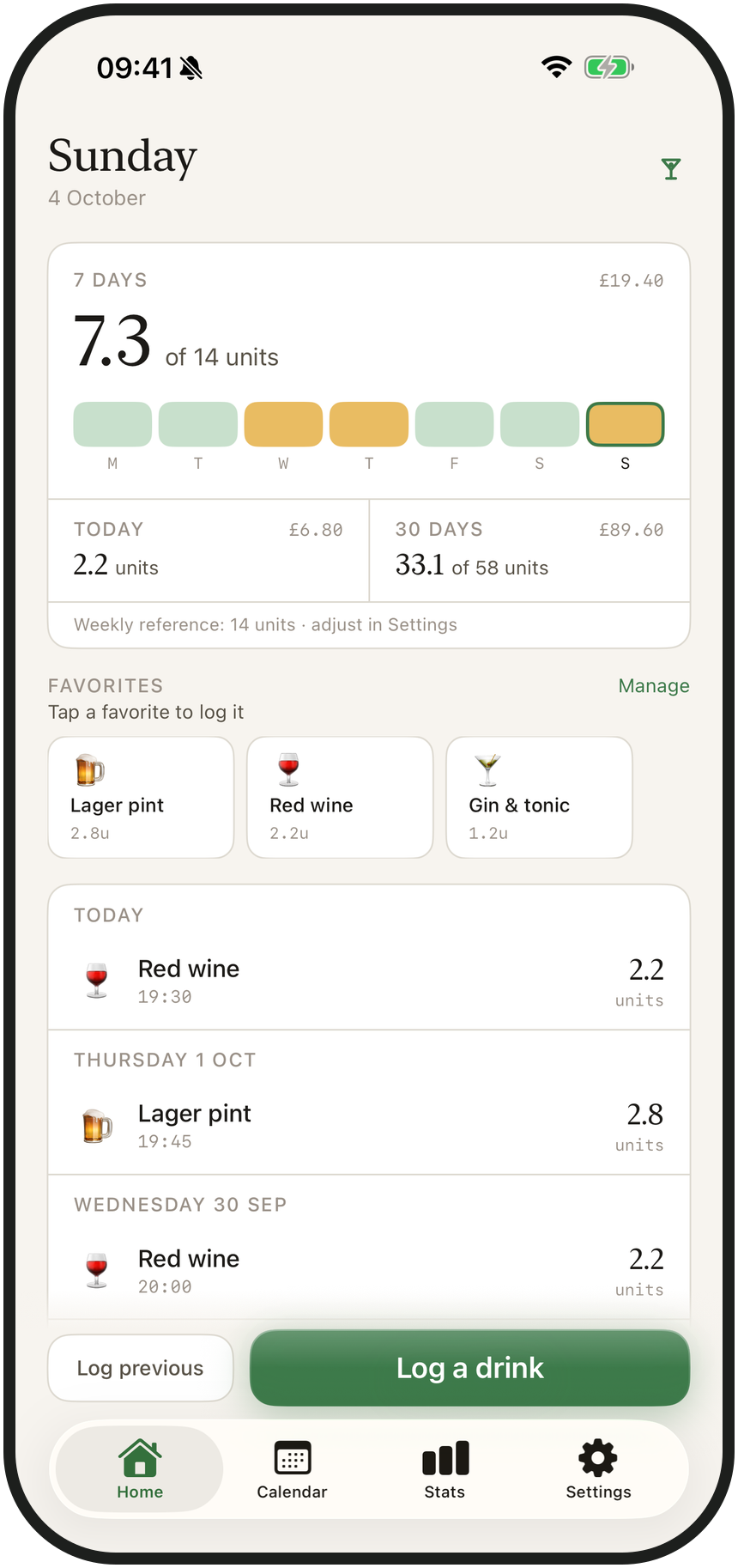
A calculator answers a question about one glass. What a normal week actually adds up to needs the same sum repeated without you thinking about it. That is what Modraly does: save the drinks you actually order as favourites, log one in two taps, and the week's total sits next to your country's reference figure.
No account, no server, no coaching, and no opinion about the number. Modraly is not a medical device and does not provide medical advice.
Free to download. Logging is unlimited, always.
Common questions
How do you calculate alcohol units?
Multiply the volume of the drink in millilitres by its ABV percentage, then divide by 1,000. A 568 ml pint at 4.5% ABV is (568 x 4.5) / 1000 = 2.6 UK units. A 175 ml glass of wine at 13% is (175 x 13) / 1000 = 2.3 units.
How many units are in a pint of beer?
A UK pint of 4.5% lager is about 2.6 units. A pint of 3.8% bitter is about 2.2 units, and a pint of 5.6% strong lager is about 3.2 units. Strength matters more than people expect: two pints of strong lager is almost exactly the same alcohol as three pints of bitter.
How many calories are in a glass of wine?
A 175 ml glass of 13% wine contains about 18 grams of pure alcohol, which is roughly 127 calories from the alcohol alone. Residual sugar adds more. A dry wine is close to that figure; a sweet one is well above it.
Is a UK unit the same as a standard drink?
No. A UK unit is 8 g of pure alcohol. A French verre standard and an Australian standard drink are 10 g, a Danish genstand and an Italian unità alcolica are 12 g, a Canadian standard drink is 13.45 g, and a US standard drink is 14 g. This calculator shows all of them at once so you do not have to convert between guidance from different countries.
Does the calculator send my drinks anywhere?
No. The calculation runs in your browser. There is no account, no cookie for it, and nothing is sent to a server. That is the same principle the Modraly app is built on.
How many units are in a gin and tonic?
A single with 25 ml of 40% gin is 1.0 UK unit (25 x 40 / 1000). A double with 50 ml is 2.0. The tonic adds no units, slimline or not; only an alcoholic mixer would.
How many units are in a bottle of wine?
A 75 cl bottle at 13% is 9.8 UK units (750 x 13 / 1000 = 9.75). At 12% it is 9.0, at 14% it is 10.5. One bottle is most of the UK 14-unit week.
How many calories are in a pint of beer?
A UK pint of 4.5% lager carries about 143 calories from the alcohol alone: 568 ml x 4.5% is 25.6 ml of pure alcohol, about 20 g, at 7.1 kcal per gram. Carbohydrate in the beer adds more, so the figure on a label is usually higher.